What Really Puts a Residency Program at Risk During Reaccreditation
A medical residency program rarely enters reaccreditation at risk because of a single document.
What usually weakens institutional confidence is the silent accumulation of small failures throughout the year: meeting minutes that were never finalized, evidence sitting in someone's email, an unresolved issue that no one owned, a mandatory procedure that was not tracked, a resident at risk that no one identified in time.
When the visit approaches, none of this feels small anymore.
It becomes urgent.
It becomes rework.
It becomes uncertainty for the program coordination, COREME, the administrative team, and institutional leadership.
The reaccreditation visit does not create the problem. It reveals what the institution allowed to accumulate.
The Visit Does Not Put the Program at Risk. The Previous Year Does.
In practice, a medical residency program starts preparing for the next evaluation cycle the day after the last report.
But many institutions only feel the weight of reaccreditation when the visit appears on the calendar.
That is when the team realizes it needs to:
- rebuild institutional history;
- locate documents;
- verify evidence;
- organize responses;
- review whether the training plan was fulfilled;
- involve people who may no longer be in the same role;
- turn months of fragmented routine into a coherent institutional narrative.
This is the most common mistake: treating reaccreditation as an event.
Reaccreditation should not be a last-minute task force. It should be the natural result of a well-monitored routine.
When that does not happen, the institution enters emergency mode.
And emergency mode is never a good sign for an institution that needs to demonstrate organization, continuity, control, and real oversight of resident training.
What Most Often Puts a Residency Program at Risk During Reaccreditation?
The main factors that put a medical residency program at risk during reaccreditation are recurring documentation failures, lack of organized evidence, incomplete records, accumulated pending issues, weak oversight of resident training, and difficulty demonstrating institutional continuity.
The issue is not only whether a file exists.
The issue is whether the program can clearly and quickly prove that it maintained a consistent routine over time and that its residents fulfilled the expected training plan.
In general, risk appears in two fronts that accumulate together:
| Risk front | What happens in practice |
|---|---|
| Resident training | Goals, procedures, logbook, and progress remain without continuous oversight |
| Documentary evidence | Evidence, minutes, records, and history become scattered or incomplete |
When one of these fronts fails, the other suffers as well.
1. Evidence That Exists, But No One Can Find
Many institutions perform the activities, record decisions, and conduct important routines.
Even so, when they need to present evidence, the questions begin:
- Which folder is it in?
- Who received this file?
- Which version is final?
- Is it in someone's email?
- Was it saved in Drive, on the administrative computer, or in a messaging group?
This is one of the most dangerous points because it creates a false sense of security.
The institution believes it has what it needs. But when it has to respond, it discovers that the evidence exists in a fragmented, informal, or hard-to-retrieve form.
During reaccreditation, what cannot be demonstrated clearly can become a doubt.
And doubt, in an evaluation process, increases risk.
2. Incomplete Records That Seem Too Small to Worry About
An isolated pending item may seem manageable:
- a missing attendance list;
- meeting minutes without closure;
- a document without clear identification;
- an update left for later.
The problem is that these small gaps rarely appear alone. They repeat, spread, and start forming a pattern.
When the team realizes it, it is no longer dealing with one pending document. It is dealing with a trail of inconsistencies.
This kind of failure wears the institution down because the team has to explain the past while trying to solve the present.
3. Documents Scattered Across People, Folders, and Channels
One of the biggest administrative risks in medical residency programs is dependence on individual memory.
When only one person knows where everything is, the institution does not have control. It has dependency.
This becomes even more sensitive during leadership transitions, changes in coordination, administrative turnover, or internal reorganization.
Institutional knowledge needs to survive people.
If every cycle starts with the team trying to understand where the previous cycle stopped, the program loses time, energy, and predictability.
And when the visit approaches, that loss becomes very visible.
4. Pending Issues That Only Become Visible Near the Visit
Almost every institution knows this scene: shortly before an evaluation, demands that seemed resolved begin to reappear.
- A document needs to be updated.
- Information needs to be validated.
- Evidence needs to be located.
- A logbook needs to be checked.
- A training goal needs to be explained.
- A response depends on someone who is now in another role.
The problem did not begin that week. It only became visible that week.
For months, the pending issue was there, growing without creating enough alarm.
That is one of the greatest pains of reaccreditation: discovering too late that the risk had been accumulating all along.
5. No Clear View of What Is Ready, Pending, or Vulnerable
Without a clear view of the program's status, management works by feeling.
And feeling is not enough to sustain a critical routine.
The coordination may believe everything is on track. The administrative team may think a pending item has already been resolved. Leadership may only discover the problem when it has already become urgent.
This lack of visibility creates friction between areas and increases rework.
More than organizing files, the institution needs to see what deserves attention before it becomes a problem.
What Management Needs to See
- Which residents are progressing as expected.
- Which residents require attention.
- Which goals or procedures still need to be monitored.
- Which evidence is ready.
- Which documents still require validation.
- Which pending issues already represent risk for the evaluation cycle.
6. Preparation Concentrated in a Few Weeks
When reaccreditation preparation becomes a race, the team starts operating under pressure, interruptions, and reactive decisions.
This consumes the time of strategic people and pulls focus away from clinical, academic, and administrative routines.
The real cost is not only the effort of organizing documents.
It is the cost of stopping the institution to rebuild something that should have been monitored throughout the entire year.
7. Residents Approaching the End of the Program With Training Gaps
One of the most sensitive risks is discovering too late that a resident is approaching the end of the program without completing required procedures, goals, or stages in the training plan.
The problem is not only the gap. It is the gap appearing when there is little time left to correct it.
When training oversight is fragmented, the program loses the chance to act earlier. The coordination only sees the risk when it has already become difficult to address.
During reaccreditation, this matters because the institution needs to demonstrate that it monitored training, not only that it archived documents.
Warning Signs
- Incomplete logbook.
- Required procedures without clear oversight.
- Training goals without visibility.
- Resident at risk identified too late.
- Documentary evidence disconnected from resident progress.
8. Lack of Longitudinal Resident Monitoring
Medical training does not happen in a single moment.
It is built throughout the program.
That is why monitoring a resident only at isolated points creates an incomplete view. The program may only discover at the end of the cycle that someone is below expectations, with weak records, pending goals, or inconsistent progress.
The risk, once again, is not only that a pending issue exists.
It is discovering the pending issue too late.
Without longitudinal monitoring, the institution loses visibility into:
- who is progressing well;
- who requires attention;
- which points need to be corrected before the visit;
- which evidence proves that trajectory.
The Most Common Mistake: Confusing Document With Evidence
A document is a file.
Evidence is context.
A loose file may answer a question, but it does not always demonstrate continuity, decision-making, responsibility, or history.
That is why many programs struggle even when they have a large volume of stored documents.
The problem is not lack of material. It is lack of institutional organization around that material and lack of continuous oversight of the training that the material should prove.
A program may have minutes, lists, reports, communications, and several records. But if everything is scattered, without status clarity and without a monitoring line, the institution remains vulnerable.
In reaccreditation, the question is not only "does the file exist?"
Did the program train its residents as expected, monitor that journey over time, and can it prove it with confidence?
What No One Tells You Before the Visit
The burden starts before the evaluation.
It starts when the team realizes it will need to search, check, request, resend, rename, review, and rebuild information that should already be under control.
What no one tells you before the visit is that the fear of reaccreditation is rarely fear of the visit itself.
It is fear of:
- discovering too late that the institution does not control its own history;
- realizing there is no clarity about resident training compliance;
- depending on specific people;
- not being able to respond clearly;
- seeing a small failure look bigger because it appeared at the worst possible moment.
And that fear makes sense.
Medical residency programs operate in a regulated environment, evaluated and monitored by formal bodies. CNRM acts in the regulation, supervision, and evaluation of institutions and programs, and acts related to accreditation, reaccreditation, recognition, and renewal demand institutional consistency.
But the point here is not to turn the routine into a legal opinion.
The point is to understand that when the institution does not continuously monitor resident training and the evidence that proves that training, it only sees the risk when the risk has already become expensive.
Reaccreditation Is Not a Folder. It Is a Routine.
Organizing a folder near the visit may solve an urgent need.
But it does not solve the underlying problem.
The underlying problem is the lack of continuous monitoring of training and institutional proof.
When the institution only mobilizes at the end of the cycle, it loses the chance to:
- correct small gaps;
- monitor residents at risk;
- record decisions at the right time;
- preserve history while it is still alive;
- prove training progress with confidence.
On the other hand, when management monitors training, pending issues, and evidence throughout the year, reaccreditation stops being a shock.
It becomes a consequence.
Not because everything became simple.
But because the risk stopped being invisible.
How to Reduce Risk Before Reaccreditation
The safest preparation for the reaccreditation of a medical residency program does not begin when the visit is scheduled.
It begins with a management routine capable of reducing information loss, rework, training gaps, and dependence on individual memory.
In practice, this means:
- keeping important evidence organized throughout the year;
- monitoring whether each resident is fulfilling the training plan, procedures, and expected goals;
- tracking pending issues before they become urgent;
- preserving institutional history between management cycles;
- reducing dependence on personal files, loose messages, and parallel folders;
- giving more clarity to coordination, administration, COREME, and leadership;
- turning silent risk into a visible point of attention.
This is where LIMHUB operates.
LIMHUB is a training compliance platform for medical residency programs.
It helps the institution continuously monitor whether each resident is fulfilling the training plan, procedures, and expected goals throughout the program.
At the same time, it organizes the documentary proof that supports that monitoring: evidence, history, pending issues, and critical records to demonstrate institutional continuity.
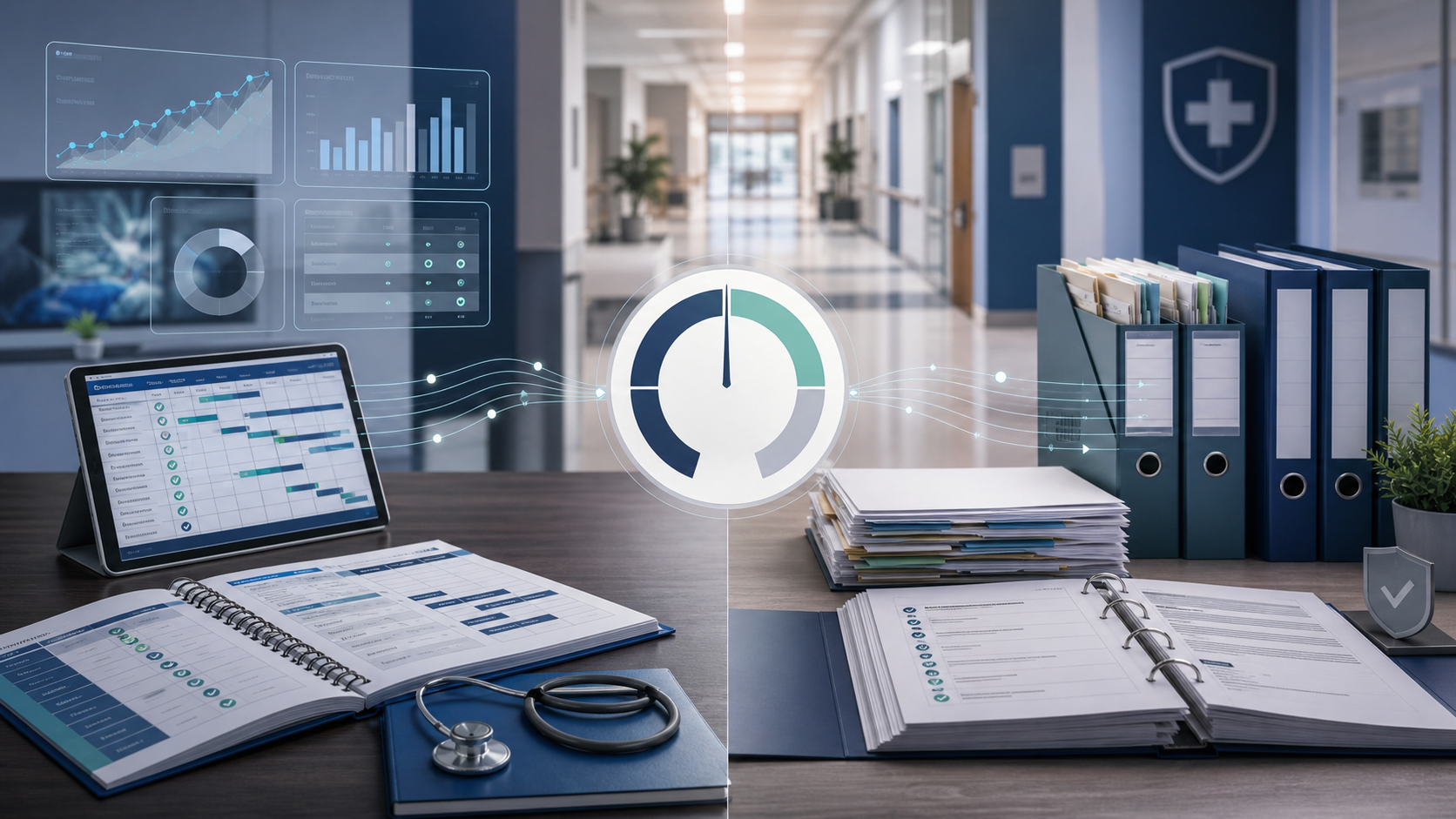
These two halves meet in the Training Compliance Index.
| What strengthens the Index | What lowers the Index |
|---|---|
| Training monitored continuously | Resident at risk discovered late |
| Logbook and goals under visibility | Procedures pending without action |
| Evidence organized | Documents scattered |
| Institutional history preserved | Dependence on individual memory |
| Pending issues addressed early | Last-minute rush |
The Index summarizes, in a single indicator, how compliant the program is considering both resident training and the documentation that proves that training.
When training is being fulfilled and evidence is organized, the Index rises.
When there is a pending issue in either of the two sides, the Index falls.
The Training Compliance Index turns scattered risk into a visible signal before the eve of the visit.
The objective is not to prepare a last-minute race.
It is to prevent that race from being necessary.
Frequently Asked Questions About Medical Residency Reaccreditation
What can harm a medical residency program during reaccreditation?
Documentation failures, lack of organized evidence, incomplete records, accumulated pending issues, gaps in training oversight, and difficulty demonstrating institutional continuity can harm a medical residency program during reaccreditation.
Why does a reaccreditation visit create so much uncertainty?
A reaccreditation visit creates uncertainty because many institutions only notice training and documentation gaps when they need to present evidence quickly. The problem usually accumulates throughout the year and becomes visible near the evaluation.
Can poor document organization affect reaccreditation?
Yes. Even when activities were performed, poor document organization can make proof harder, generate rework, and increase the perception of risk during the evaluation process.
Why does monitoring resident training plan completion matter in reaccreditation?
Because proving training requires demonstrating that each resident fulfilled the procedures, goals, and stages expected throughout the program. Continuous monitoring helps avoid discovering gaps too late, when there is little time left to correct them.
When should an institution start preparing for reaccreditation?
Preparation for reaccreditation should be continuous. The ideal approach is to keep documents, evidence, training progress, and pending issues monitored throughout the entire program cycle, not only when the visit approaches.
What is the biggest mistake in preparing for medical residency reaccreditation?
The biggest mistake is treating reaccreditation as an isolated event. When preparation happens only in the weeks before the visit, old problems tend to appear all at once.
How can a program reduce risk before a medical residency visit?
The institution reduces risk when it monitors training compliance, keeps evidence organized, tracks pending issues continuously, preserves institutional history, and avoids depending on information scattered across people, emails, folders, and informal channels.
How does LIMHUB help medical institutions in this context?
LIMHUB helps medical institutions monitor resident training compliance and organize the documentary proof of that journey. The Training Compliance Index summarizes these two dimensions into an indicator that makes risks and pending issues more visible throughout the year.
Referências
- https://portal.mec.gov.br/conaes-comissao-nacional-de-avaliacao-da-educacao-superior/114-conhecaomec-1447013193/sistemas-do-mec-88168494/12233-cnrm
- https://www.gov.br/mec/pt-br/residencia-medica/decretos/decreto_7562_2011.pdf
- https://portal.mec.gov.br/sesu/arquivos/pdf/cnrm_092004.pdf
- https://www.gov.br/saude/pt-br/composicao/sgtes/residencias-em-saude/publicacoes/3-gestao-administrativa-de-programa-de-residencia-medica-web.pdf